Tips
Virtual Corporate Cards vs. Traditional Expense Reports in Business Travel
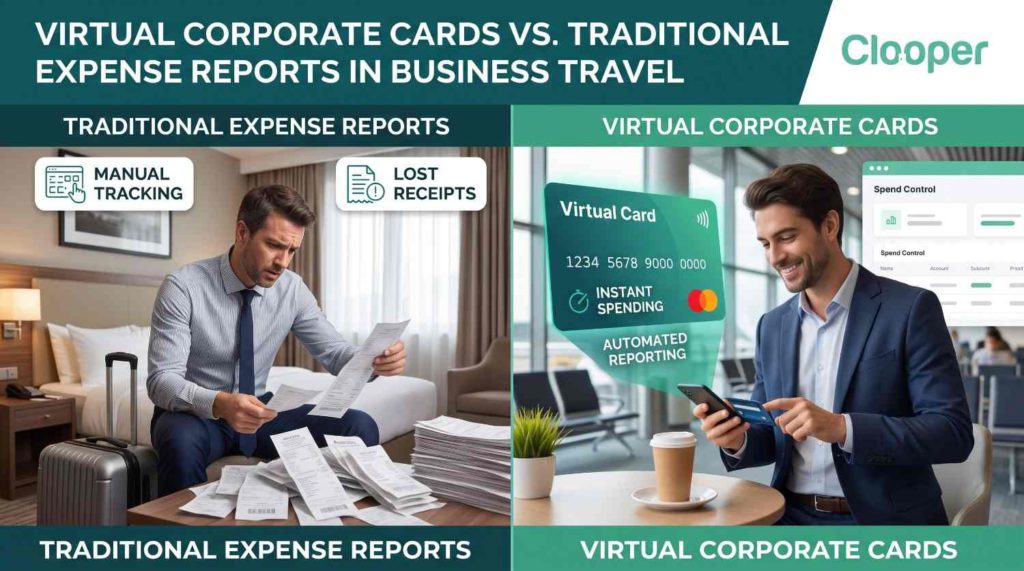
For decades, the financial workflow of business travel has relied on a deeply flawed, reactive model: the traditional expense report.
In this legacy system, an employee travels for business, pays for flights, hotels, and client dinners out of their own pocket (or on a shared physical company credit card), collects crumpled paper receipts, and submits a convoluted spreadsheet at the end of the month. The finance team then spends hours verifying compliance, manually coding transactions into the general ledger, and issuing delayed reimbursements.
This process transforms employees into zero-interest lenders for the company and traps finance teams in endless cycles of administrative detective work.
In 2026, agile organizations are abandoning this model entirely. By integrating virtual corporate cards into modern travel and expense management software, companies are shifting financial compliance from a retroactive audit to a proactive control.
Below, we break down the exact mechanical differences between traditional expense reporting and virtual corporate cards, and why modern finance teams are universally adopting the latter.
What is a Virtual Corporate Card?
A Virtual Corporate Card (or Virtual Card Number – VCN) functions exactly like a standard physical credit or debit card, but it exists entirely in a digital format.
Generated instantly via a travel management or fintech dashboard, a virtual card provides a unique 16-digit card number, CVV, and expiration date. These cards can be securely pushed directly into an employee’s mobile wallet (Apple Pay or Google Wallet) for contactless, in-person payments, or used online for booking flights and software subscriptions.
Unlike a traditional plastic card issued by a legacy bank, virtual cards are heavily programmable. A finance manager can instantly generate a card and encode it with strict, unbreakable rules regarding exactly when, where, and how much can be spent.
The Critical Failures of Traditional Expense Reports
To understand why virtual cards have become the industry standard, we must first examine the hidden costs and operational friction of traditional expense reporting.
1. The “Float” and Employee Financial Strain
When companies require employees to pay out-of-pocket for travel expenses, they force their staff to float corporate debt. A three-day international trip can easily cost $2,000 in flights, hotels, and meals. For younger employees or those without high-limit personal credit cards, this creates significant financial stress. Furthermore, if reimbursements take 30 to 60 days to process, employees may incur personal interest charges on company expenses—a massive blow to company morale and culture.
2. Retroactive Policy Enforcement (The Compliance Trap)
Expense reports are inherently reactive. Finance teams only see an expense after the money has left the employee’s account. If an employee violates your corporate credit card policy by booking a first-class train ticket instead of standard class, the finance team is put in a terrible position: they must either refuse the reimbursement (infuriating the employee) or approve the non-compliant spend (setting a bad precedent and leaking company budget).
3. The Nightmare of the “Shared” Physical Card
Many small businesses attempt to solve the reimbursement issue by passing around a single physical corporate credit card (e.g., “The CEO’s Amex”). This creates two massive risks:
- Security: Card details are inevitably written down, emailed, or shared over Slack, exponentially increasing the risk of fraud.
- Reconciliation: At the end of the month, the finance controller stares at a $15,000 credit card bill with dozens of transactions, having no idea which employee made which purchase, or for which client project.
4. Manual Ledger Reconciliation
According to the Global Business Travel Association (GBTA), processing a single manual expense report costs a company an average of $58 in labor and takes 20 minutes of dedicated finance time. If a receipt is lost or a code is entered incorrectly, the cost of correcting that single report skyrockets.
5 Distinct Advantages of Virtual Corporate Cards
Switching to virtual cards flips the financial model from reactive data entry to proactive automation. Here is why virtual cards outmaneuver traditional expense reports across every metric.
1. Hyper-Granular, Programmable Spend Controls
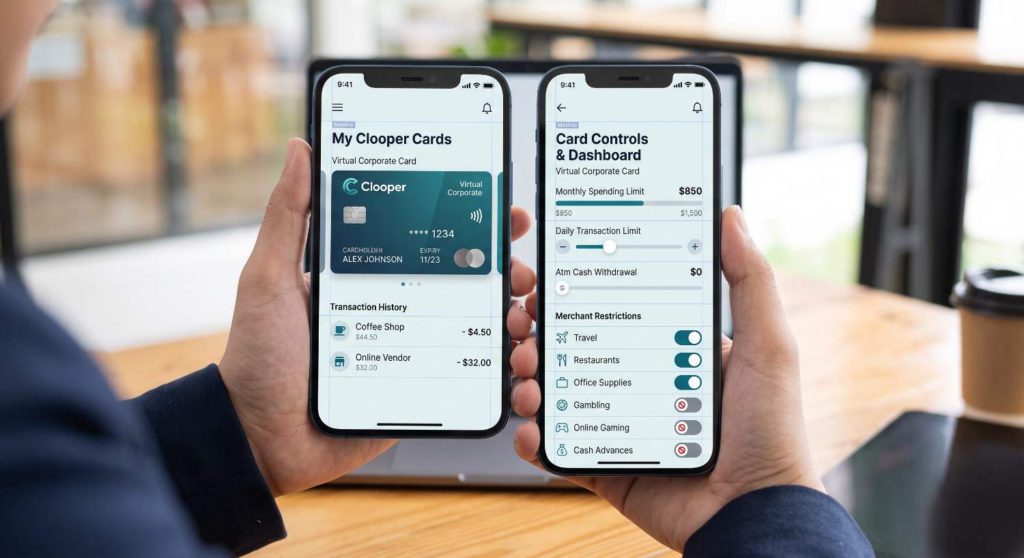
The defining feature of a virtual card is the ability to program its parameters before a single cent is spent. When an employee is approved for a trip to London, a manager can generate a specific virtual card for that trip with the following hardcoded constraints:
- Budget Limit: Exactly £1,500. The card will decline any transaction pushing the balance to £1,501.
- Date Restrictions: The card activates on Monday at 8:00 AM and permanently self-destructs on Thursday at 5:00 PM when the trip ends.
- Merchant Category Code (MCC) Blocking: The card is programmed to only authorize transactions at Airlines, Hotels, and Restaurants. If the employee attempts to use the card at a retail clothing store or a casino, the transaction is instantly declined at the terminal.
2. Real-Time Reconciliation (The Death of Month-End Close)
With traditional expense reporting, the accounting department operates weeks in the past. With virtual cards integrated into modern expense software, reconciliation happens in real-time. When an employee taps their phone to pay for a client dinner, the virtual card captures the merchant data, amount, and time. The employee immediately receives a push notification prompting them to snap a photo of the receipt. The software instantly merges the receipt with the transaction data and pushes the completed entry into your accounting software (like Xero or QuickBooks). The expense report builds itself.
3. Total Security and Fraud Isolation
Physical cards are vulnerable to skimming, theft, and online data breaches. If a traditional corporate card is compromised, the company must freeze the account, disrupting travel and software subscriptions company-wide while waiting weeks for a new plastic card to arrive in the mail. Because virtual cards can be generated for single-use transactions, fraud is effectively isolated. If a virtual card used to book a specific hotel is compromised in a vendor data breach, the hacker gets nothing, as the card was already programmed to expire or freeze after that specific transaction.
4. Effortless Subscription and Vendor Management
Beyond travel, virtual cards are the ultimate tool for managing SaaS subscriptions and vendor payments. Instead of putting AWS, Zoom, and HubSpot on the founder’s single corporate card, you can issue a dedicated virtual card for each software vendor. If you want to cancel a subscription and the vendor makes it difficult, you simply delete that specific virtual card with one click. It gives your procurement team ultimate leverage and prevents shadow IT spend.
5. Improved Employee Experience
Top-tier talent expects frictionless technology. Forcing new hires to float company expenses and navigate clunky legacy spreadsheets signals that a company is operating in the past. Providing them with a seamless digital wallet experience demonstrates trust and modern operational maturity.
Why Standalone Virtual Cards Are Not Enough
While virtual cards are a massive upgrade over traditional reports, simply acquiring virtual cards from a digital bank is only half the solution.
If your virtual cards are disconnected from your travel booking platform, your finance team still suffers from fragmented data. You will have flight itineraries sitting in one system, and the credit card transaction sitting in another.
To achieve true automation, you must unify your payments with your travel inventory. This is the core philosophy of small business travel management.
By utilizing a unified platform like Clooper, the ecosystem is completely closed-loop:
- The employee searches for a flight within the Clooper dashboard.
- The platform verifies the flight is within company policy.
- A virtual card is automatically generated in the background to pay the airline.
- The digital itinerary, tax invoice, and payment receipt are instantly consolidated and synced to your general ledger.
No employee floats cash. No manager chases receipts. No finance controller wastes their Friday manually matching credit card statements to travel itineraries.
The Verdict: Make the Switch
Traditional expense reports were a necessary evil in a world where corporate payments and travel inventory were siloed. Today, that friction is entirely optional.
Virtual corporate cards provide absolute control over company capital, protect organizations from fraud, and eliminate thousands of hours of administrative waste. Transitioning away from manual reimbursements is no longer just a technological upgrade—it is a baseline requirement for a financially healthy, scalable business.
Ready to eliminate expense reports forever?
Book a live demo of Clooper today and see how our unified travel and expense platform automates your financial workflows from booking to reconciliation.