Visa
Schengen Visa Requirements for Nigerians: Documents, Fees and How to Apply
A Schengen visa gives Nigerian travellers access to 29 European countries on a single permit, for up to 90 days within any 180 days. One visa. Twenty-nine countries. That is the appeal. The challenge is that in 2024, the European Commission confirmed that 45.9% of all Schengen visa applications from Nigeria were rejected. That is nearly one in two. It is the third-highest refusal rate in the world, behind Bangladesh and Senegal, and it went up from 40.8% the year before.
The applications that succeed are not necessarily from applicants who are wealthier or more well-travelled. They are from applicants who understood exactly what the embassy was looking for and built their file accordingly. This guide gives you the complete, verified requirements for a Schengen visa application from Nigeria, the full cost breakdown in naira, a step-by-step application process, country-by-country processing times, and the specific reasons why Nigerian applications get rejected and what you can do about each one.
What Is a Schengen Visa and Which Countries Does It Cover?
A Schengen visa is an entry permit that allows you to travel freely across all member states of the Schengen Area for short stays. The Schengen Zone covers 29 European countries, where a Type C visa grants you access to all member states for up to 90 days within any 180 days.
As of 2025, Bulgaria and Romania have fully joined the zone, meaning your Schengen visa now covers more ground than ever before.
The 29 Schengen member states as of 2026 are:
Central and Western Europe: Austria, Belgium, France, Germany, Liechtenstein, Luxembourg, Netherlands, Switzerland
Southern Europe: Croatia, Greece, Italy, Malta, Portugal, Spain
Northern Europe: Denmark, Estonia, Finland, Iceland, Latvia, Lithuania, Norway, Sweden
Eastern Europe: Bulgaria, Czech Republic, Hungary, Poland, Romania, Slovakia, Slovenia
Note on non-EU members: Switzerland, Norway, and Iceland are part of the Schengen Area but are not European Union members. Non-EU countries like Switzerland, Norway, and Iceland are part of the Schengen region. Your Schengen visa covers them all the same.
There are three types of Schengen visa. The Type A airport transit visa is for passing through a Schengen airport without entering the country. The Type C short-stay visa is what most Nigerian travellers need for tourism, business, family visits and conferences, valid for up to 90 days. The Type D long-stay national visa is issued by individual countries for stays longer than 90 days and does not grant access to other Schengen states.
Which Embassy Do You Apply To?
Schengen visas must be applied for at the respective Embassy or Consulate of the country of your main destination. Your main destination will be the Schengen country where your duration of stay exceeds all other countries. In case of equal stay, you must submit your application to the mission of the Schengen country representing your first port of entry.
This is one of the most common sources of confusion for Nigerian applicants planning multi-country European trips. If you are spending five days in Italy, three days in France, and two days in Germany, you should apply at the Italian embassy. If the split is equal across countries, apply at the first country you will enter.
Applying at the wrong embassy does not automatically result in refusal, but it can delay your application and create unnecessary complications. Always match your application to your itinerary.
Schengen Visa Requirements: Full Documents Checklist for Nigerian Applicants
These are the documents required for a Type C short-stay Schengen visa application from Nigeria. Every document on this list is mandatory unless stated otherwise. Missing any single item is grounds for an incomplete application, which means your appointment is wasted and your fee is non-refundable.
Personal Documents
Valid Nigerian passport: must have at least three months of validity beyond your intended return date, must not have been issued more than ten years ago, and must have at least two blank pages for the visa sticker and entry stamps. If your passport has less than six months of remaining validity, renew it before applying.
Two recent passport photographs: 35mm by 45mm, white background, taken within the last six months. Two recent passport-size photographs of 35 by 45mm on a white background taken within the last six months are required across all Schengen consulates. VFS Global offers an in-centre photo service if needed.
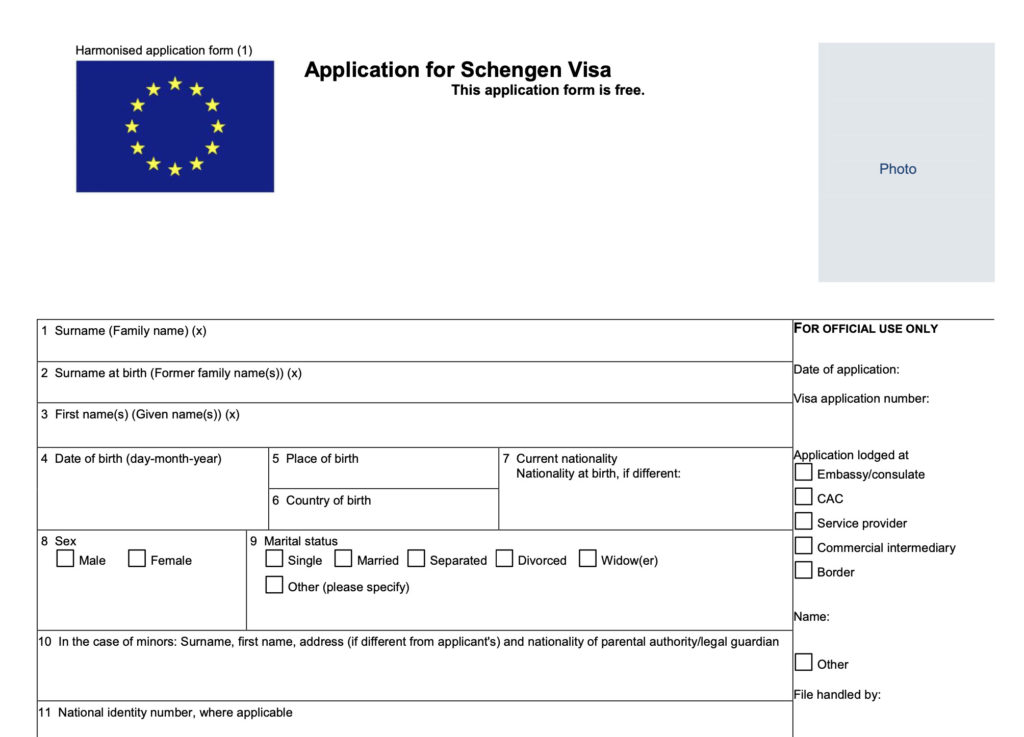
Completed Schengen visa application form: free of charge and obtained from the official VFS Global, TLSContact or BLS International portal, depending on your destination country. Countries like France and Germany require you to complete a digital version online before printing. Never pay anyone for the application form. If you are charged for the form itself, that is a scam.
National ID card or NIN slip: some embassies request this as a supplementary identity document. Include it as a matter of course.
Travel Documents
Round-trip flight reservation: a confirmed reservation showing entry into and exit from the Schengen Area. You do not need to purchase a full non-refundable ticket before your visa is approved. A refundable or hold booking from a recognised airline is acceptable at most consulates. Purchase the confirmed ticket only after you receive your visa.
Proof of accommodation: hotel booking confirmations or Airbnb reservations for every night of your stay. If staying with a host in a Schengen country, an invitation letter from the host along with a copy of their passport or residency document, and their registration certificate is required.
Detailed itinerary: a day-by-day plan of your trip. First-time Schengen applicants in particular benefit significantly from submitting a clear itinerary that shows exactly where you will be each day, how you are travelling between destinations, and what the purpose of each leg is. This is especially important for business travel, where the itinerary should reference specific meetings, events or conference registrations.
Financial Documents
Bank statements: three to six months of consecutive statements from a recognised Nigerian bank, showing regular income credits rather than lump sums deposited specifically for the application. Proof of financial means and ties to Nigeria, such as a bank statement and employment letter, are core requirements across all Schengen applications.
The Schengen financial requirement is typically calculated as a minimum daily spend per day of your trip. As a general benchmark, most embassies expect evidence of at least €50 to €100 per day of the intended stay. The pattern of deposits is more important than the peak balance. Regular salary credits over six months are far more credible than N2 million appearing in an account the week before the application.
Proof of income or financial sponsorship: payslips for the last three months, a tax clearance certificate or evidence of business income for self-employed applicants. If a third party is sponsoring your trip, a formal sponsorship letter along with the sponsor’s bank statements and proof of their legal income is required.
Employment and Ties to Nigeria
Employment letter: on company letterhead, signed by a senior officer, confirming your role, salary, length of employment and that you have been granted leave for the travel period. The letter must include the company’s address, phone number and a verifiable contact for the embassy to call.
For business owners: CAC registration certificate, Form CO7, and evidence of active business operations such as recent invoices, contracts or tax filings.
Proof of ties to Nigeria: This is arguably the most important category in your entire file. The Schengen system is looking for clear evidence that you have compelling reasons to return to Nigeria after your trip. Ties that matter include property ownership documents or a tenancy agreement, evidence of dependent children or family members in Nigeria, a letter of employment with a long-term contract, evidence of ongoing business obligations, and proof of upcoming commitments in Nigeria, such as registered events or contracts.
A Nigerian applicant with a registered business, a child in school in Abuja, and a tenancy agreement has a fundamentally stronger ties profile than a young single applicant with no fixed employment. This is not about discrimination. It is about the objective risk assessment that every Schengen embassy applies to every application.
Insurance
Schengen travel insurance: mandatory for all applicants. The insurance coverage limit should not be less than €30,000 or an equivalent amount in another currency. The insurance policy should cover your costs in case of sudden illness or accident, and provide assistance on site. The policy must be valid for the entire duration of your stay and must cover all 29 Schengen member states, not just your primary destination.
Travel insurance for a Schengen trip from Nigeria typically costs between N1,500 and N67,000, depending on the provider, the duration of coverage, and whether you buy from a local Nigerian insurer or an international provider. Confirm that the policy you purchase meets the minimum €30,000 coverage threshold before submitting it with your application.
Schengen Visa Fees for Nigerians (With Naira Breakdown)
As of early 2026, the standard application fee for a short stay Schengen visa (Type C) is €90 for adults. Children between 6 and 11 years pay €45. Children under 6 are free of charge.
The fee is paid in naira at the embassy or application centre rate on the day of your appointment. The naira equivalent changes with the exchange rate and is confirmed at the point of payment. Based on current EUR/NGN rates in July 2026, the adult fee of €90 works out to approximately N155,000 to N175,000.
| Applicant Type | Official Fee | Approx. Naira (Jul 2026) |
|---|---|---|
| Adults (12 and above) | €90 | N155,000 to N175,000 |
| Children (6 to 11 years) | €45 | N77,000 to N87,000 |
| Children under 6 | Free | N0 |
On top of the government fee, you will pay a VFS Global or application centre service fee. The total Schengen visa application cost is €90 for adults plus an additional VFS service fee of roughly N25,000 to N40,000, and all fees are non-refundable even if your application is rejected. Spain’s BLS International centre charges N28,800 per application as a service fee.
Additional costs to factor in:
| Cost Item | Estimated Amount |
|---|---|
| Government visa fee (adult) | N155,000 to N175,000 |
| VFS Global or centre service fee | N25,000 to N40,000 |
| Schengen travel insurance | N1,500 to N67,000 |
| Passport photographs | N2,000 to N5,000 |
| Courier passport return (optional) | N5,000 to N10,000 |
| Transport to Lagos or Abuja centre | N5,000 to N20,000 |
| Estimated Total | N193,500 to N317,000 |
A rejected application from Lagos now costs upwards of N150,000 or more when all associated costs are totalled. The non-refundable nature of the fee deserves to be taken seriously. If your application is rejected, the €90 is gone.
Which Application Centre Do You Use in Nigeria?
The application centre you use depends on the destination country. Different Schengen member states have contracted different VAC operators in Nigeria:
VFS Global handles applications for Germany, Austria, Italy, the Netherlands, Sweden, Norway, Iceland, and several others. Centres are in Lagos (Manor Hall, Victoria Island) and Abuja (Sterling Bank Plaza, Utako).
TLSContact handles applications for France and Belgium. Centres in Lagos and Abuja.
BLS International handles applications for Spain. Present in Lagos and Abuja.
For some smaller Schengen countries without a dedicated application centre in Nigeria, applications are submitted directly at the relevant embassy or through an accredited partner. Always confirm the correct submission channel on the official embassy website of your destination country before booking an appointment.
How to Apply for a Schengen Visa from Nigeria: Step by Step
Step 1: Determine your main destination and the correct embassy. Match your application to the country where you will spend the most time, or your first port of entry if stays are equal across countries.
Step 2: Gather your documents. Work through the full checklist above before booking your appointment. Do not book until every document is in hand. Incomplete applications are not processed and fees are not refunded.
Step 3: Complete the application form. Download or complete the form online through the official VAC portal for your destination country. The form is always free. Fill every field. Sign and date the completed form.
Step 4: Book your appointment. Schedule your biometrics appointment at the relevant centre in Lagos or Abuja as early as possible. Schengen visa application in Nigeria requires booking a VFS Global appointment at least two months in advance. During peak seasons from June to September and around December, slots fill weeks in advance.
Step 5: Attend your appointment and submit your documents. Arrive on time. Applicants who arrive late for their appointment cannot be accommodated and must book a new appointment. Bring every document in its original along with one set of photocopies. Pay the visa fee and service charge at the centre. Documents sent in advance cannot be considered. It is not possible to process incomplete applications.
Step 6: Provide biometrics. All Schengen countries now issue biometric visas only. Applicants aged 12 and above must be present in person to provide biometric data, including ten fingerprints and a digital photograph. Biometrics are stored in the Visa Information System and are valid for 59 months. If you provided biometrics within the last 59 months, you may be exempt.
Step 7: Track your application and collect your passport. Processing typically takes 15 calendar days, though it can extend to 45 days for Nigerians during peak seasons. Use the VFS tracking tool with your reference number. Once a decision is made, you can collect your passport in person or opt for courier delivery.
Processing Times by Country
Not all Schengen embassies process at the same speed. For Nigerian applicants with fixed travel dates, choosing a destination with faster average processing can make a material difference.
| Country | Average Processing Time | Notes |
|---|---|---|
| Germany | 5 to 10 working days | Fastest for Nigerian applicants, generous with multi entry grants |
| Netherlands | 10 to 15 days | Reliable and consistent |
| France | 15 days | Can extend to 30 days in peak season |
| Italy | 15 to 20 days | Slower during summer |
| Spain | 15 days | BLS International in Nigeria |
| Switzerland | 15 days | Apply at Swiss Embassy directly |
| Greece | 15 to 30 days | Busier in summer months |
Germany is consistently the fastest for Nigerian applicants. If Germany is genuinely your main destination, you benefit from both fast processing and generous multi-entry visa grants.
Nigeria’s Schengen Rejection Rate and What Drives It
In 2024, 111,201 Nigerians applied for Schengen visas. Only 60,825 were approved. The 45.9% rejection rate means Nigeria is the third worst performing country in the world for Schengen approvals, behind only Bangladesh and Senegal.
African applicants are 8 times more likely to be refused than Asian applicants. Understanding why is not pessimism. It is the starting point for building an application that does not become part of that statistic.
The most common reasons Nigerian Schengen applications are refused include:
Insufficient financial proof: the most frequently cited refusal reason. This covers both the balance in the account and the credibility of how that balance was built. A large one-off deposit immediately before the application is treated with significant suspicion. Six months of regular salary credits tell a far more credible story.
Unclear travel purpose: applications that do not clearly explain why the trip is being made, who the applicant is meeting, what events they are attending, and what their daily plan is. Embassies do not fill in blanks. If the purpose is not clear from the documents, the assumption is that it has not been disclosed honestly.
Weak ties to Nigeria: the embassy’s primary concern with a Nigerian applicant is whether they will return home at the end of the trip. An applicant with no stable employment, no property, and no dependants in Nigeria presents a higher risk profile. Ties to Nigeria must be demonstrated through evidence, not asserted in the cover letter.
Missing or invalid documents: incomplete applications are returned without processing. A missing insurance certificate, a bank statement from the wrong period or an unsigned application form can result in the entire file being rejected at submission.
Prior refusals not disclosed: all Schengen consulates share rejection data through the VIS Visa Information System. A prior rejection is visible to any Schengen consulate you subsequently apply to. You must disclose prior rejections on your application form. Not disclosing is grounds for automatic rejection.
Important 2025 update: As of July 2025, the remonstration administrative review procedure has been abolished for visa rejections. Your main recourse after a refusal is to reapply with improved documentation. There is no longer an internal review mechanism for challenging a Schengen refusal. This makes getting the application right the first time more important than ever.
Which Schengen Country Is Easiest for Nigerians to Get a Visa From?
Nigerian applicants face some of the most rigorous scrutiny, with aggregate approval rates typically ranging from 65% to 75% depending on destination country and application quality. Visa NG
Based on available 2024 and 2025 data, Germany and the Netherlands tend to have the highest approval rates for Nigerian applicants among the major Schengen destinations. Germany is also the fastest processor and the most generous with multi entry visa grants for applicants with a strong travel history.
France and Italy tend to apply more scrutiny, particularly around financial evidence. Greece and Spain sit in the middle range.
For first time Schengen applicants from Nigeria, Germany or the Netherlands are the strongest starting points, provided your main destination is genuinely one of those countries. Applying to Germany simply because it has a higher approval rate, when your actual trip takes you primarily to France, is an incorrect application and will be noted.
Schengen Visa for Business Travellers from Nigeria
Nigerian executives travelling to Europe for business conferences, trade fairs, client meetings or commercial negotiations apply for the same Type C short-stay Schengen visa as tourists. The difference is in the supporting documents.
For a business Schengen application, your file should include an invitation letter from the European company or conference organiser on official letterhead specifying the dates, location and nature of the business engagement. A cover letter from your Nigerian employer or yourself, if you are a business owner, confirming the commercial purpose of the trip should also be included. Evidence of the business relationship, such as contracts, correspondence, or previous meeting records, strengthens the application considerably. Conference registration confirmation or an event programme, where applicable, should be included, along with your business cards and CAC documents for self-employed applicants.
The business travel purpose is a significant advantage in a Schengen application because it creates a specific, verifiable itinerary that officers can cross-check. A vague tourism application with no documented plan is far harder to approve than a business application with a confirmed meeting schedule.
For corporate travel managers handling Schengen applications for multiple employees, coordinating documentation across different countries, different VAC operators, and different processing timelines is a significant administrative overhead. Clooper manages Schengen visa applications for Nigerian corporate travellers as part of its end-to-end business travel service, preparing each file to the specific requirements of the destination embassy and coordinating the application timeline with the travel plan.
Frequently Asked Questions
Do Nigerians need a Schengen visa to travel to Europe?
Yes. All Nigerian citizens are required to apply for a visa before entering any country under the Schengen Agreement. There are no visa-free Schengen destinations for Nigerian passport holders. This applies regardless of the purpose of your visit, whether tourism, business, family visit or conference attendance.
What is the Schengen visa fee for Nigerians in 2026?
The standard adult fee is €90, equivalent to approximately N155,000 to N175,000 at July 2026 exchange rates, paid in naira at the application centre on the day of your appointment. Children between 6 and 11 pay €45. Children under 6 are exempt. The centre service fee of approximately N25,000 to N40,000 is charged separately.
How long does a Schengen visa take to process from Nigeria?
Processing typically takes 15 calendar days, though it can extend to 45 days for Nigerians during peak seasons. Germany is the fastest, averaging 5 to 10 working days. Apply at least six to eight weeks before your travel date to be safe, and allow for the longer end of the window during June to September.
Can I travel to all Schengen countries on one visa?
Yes. A Schengen Type C visa issued by any member state allows you to travel freely across all 29 Schengen countries for up to 90 days within any 180 days. You do not need separate visas for each country.
What is the Schengen refusal rate for Nigerians?
In 2024, the European Commission confirmed that 45.9% of all Schengen visa applications from Nigeria were rejected, the third-highest refusal rate in the world. The most common reasons are insufficient financial proof, unclear travel purpose, and weak ties to Nigeria.
Can I reapply after a Schengen refusal?
Yes, but not with the same documents. You must address the specific reasons stated in your refusal letter and significantly strengthen those areas before reapplying. As of July 2025, the administrative review procedure for remonstrations has been abolished for visa rejections. There is no internal review mechanism. Reapplication with an improved file is your only option.
Can I apply for a multiple-entry Schengen visa from Nigeria?
Yes. You can specifically request a multiple-entry visa, which allows you to enter and exit the Schengen Area more than once during the visa’s validity. Germany is particularly generous with multi-entry grants for applicants with a strong travel history. A demonstrated record of previous Schengen or UK travel significantly increases your chances of receiving a multi-entry visa.
What travel insurance do I need for a Schengen visa?
Your insurance must provide minimum coverage of €30,000, must be valid across all 29 Schengen member states and must cover the full duration of your intended stay. Always confirm the coverage limit and geographic scope before purchasing. Policies that cover only your primary destination country do not meet Schengen requirements.
Conclusion
The Schengen visa represents the most complex and most scrutinised visa application a Nigerian traveller faces, with a rejection rate approaching 46%, which reflects how demanding the process is for applicants with Nigerian passports. That figure is not a barrier to be intimidated by. It is a problem to be solved through preparation.
The applications that succeed share a common thread. They tell a coherent story supported by consistent evidence. The financial documents match the stated income. The itinerary matches the invitation letters. The ties to Nigeria are demonstrated through documents, not just claimed in a cover letter. And the application is submitted early, completely, and to the correct embassy.
Clooper manages Schengen visa applications for Nigerian business travellers and corporate teams, preparing each file against the specific requirements of the destination embassy and coordinating the visa timeline with flights, hotel bookings and ground logistics. If your organisation sends employees to Europe regularly, a managed visa service removes the administrative burden and reduces the risk of a preventable refusal disrupting a business-critical trip.
Let Clooper Handle Your Schengen Visa Application
From documents checklist to embassy submission, Clooper manages the full Schengen visa process for Nigerian business travellers. Visit clooper.com to get started.